


Who this is for: Best for dog owners who need safer, weather-proof indoor exercise and want the right treadmill fit for their dog’s size and energy level.
How to Choose the Best Dog Treadmill in 2026: Complete Buying Guide
If your dog is bouncing off the walls, missing walks because of weather, or needs a safer indoor exercise routine, choosing the right dog treadmill can make a big difference. The challenge is that not all models fit the same breeds, energy levels, or home setups, and the wrong choice can be awkward, noisy, or unsafe. This guide breaks down exactly how to choose a dog treadmill, what features matter most, what to avoid, and which researched options stand out for different needs.
Key Features to Look For
1) Size and weight capacity
The first step in how to choose a dog treadmill is matching the machine to your dog’s body size, stride length, and weight. A treadmill that is too short or too narrow can force an unnatural gait, while one with a stable frame helps your dog move confidently. Check the running surface dimensions, side panel height, and whether the product is meant for small, medium, or large breeds.
2) Manual vs. motorized design
Dog treadmills generally fall into two camps: motorized models and self-propelled slat mills. Manual designs let your dog set the pace, which can be helpful for training, conditioning, and dogs that need more control over speed. Motorized models can be useful for steady walking sessions, but they require more supervision and the right speed settings for safety.
3) Safety features and stopping control
Safety should be at the center of your decision. Look for disc brakes, secure track construction, side panels, and a reliable way to stop the belt or lock the machine when needed. Features like pin-hinged tracks, non-slip surfaces, and enclosed sides can help reduce the risk of slips and keep your dog centered during use.
4) Shock absorption and paw comfort
Dogs need a surface that is kinder to joints and paws than hard outdoor pavement. Models with layered cushioning, shock-absorbing rails, silicone-covered slats, or smoother belt materials can make exercise more comfortable, especially for older dogs or dogs returning to activity. Better cushioning can also help reduce impact during longer sessions.
5) Noise level
A quieter treadmill is usually easier to introduce and more pleasant for indoor use. This matters a lot for anxious dogs, apartment living, or homes where the treadmill may be used near workspaces. Quiet wheels, sound-absorbing belts, and low-noise motors can make a big difference in whether your dog tolerates the machine.
6) Adjustability and training control
Adjustable incline, resistance, or frame positioning can help you scale workouts as your dog builds fitness. These features are especially useful for active breeds or households that want a treadmill to support both casual movement and more structured conditioning. More adjustability also means the treadmill can serve a wider range of training goals.
7) Portability and storage
If you plan to move the treadmill between rooms, the garage, or a patio, transport wheels and manageable frame design matter. Some manual models are made for indoor-outdoor flexibility, while others are better left in one place. Think about where the treadmill will live and whether you’ll need to roll or store it regularly.
What to Avoid
1) Buying by breed label alone
“For large dogs” or “for small dogs” is only a starting point. A better fit depends on your dog’s actual height, stride, confidence, and weight. Always compare the machine’s dimensions and design to your dog’s body, not just the marketing category.
2) Ignoring the learning curve
Even the best dog treadmill may take time for your dog to accept. If you choose a model with a steep learning curve, unclear controls, or poor stability, training can become frustrating. A treadmill that supports slow introductions and controlled pacing is usually easier to succeed with.
3) Overlooking brake and lock systems
A treadmill without dependable stopping control can be awkward when removing a harness or ending a session. This is one of the most common pitfalls in how to choose a dog treadmill. A good brake or lock adds peace of mind and helps prevent accidental movement during setup and cooldown.
4) Choosing a noisy or shaky frame
If the frame wobbles or the machine sounds harsh, many dogs will hesitate to use it. Noise and instability can make training harder and may reduce the treadmill’s usefulness in a home setting. Look for verified owner feedback that mentions stable operation and manageable sound levels.
5) Skipping assembly complexity
Some treadmills arrive with more involved setup than others. If you want a simpler experience, avoid models with vague instructions or complicated parts alignment. Clear assembly guidance and a straightforward design can save time and frustration.
Our Top Picks
Below are researched picks based on manufacturer specs, published product details, and verified owner feedback patterns. Because this is a research-based guide, not hands-on testing, these recommendations focus on fit, features, and real-world usability.
Best Overall: PawArmorX98 Curved Dog Treadmill with Silicone Slats and Disc Brakes


If you want the most complete feature set for a serious indoor training setup, this model stands out. The adjustable incline, resistance damper, disc brakes, and silicone-wrapped slats give it a strong mix of control, comfort, and performance. It is especially appealing for owners who want a manual treadmill that can scale from easier walks to more demanding conditioning.
✓ Adjustable incline and resistance for progressive training
✓ Silicone slats and disc brakes for better grip and control
✓ Heavy-duty frame and quiet aluminum hubs for smoother operation
✗ Likely more treadmill than a casual user needs
✗ Best suited to dogs that are already comfortable with treadmill work
✗ Manual design may require more handler involvement than a simple walk-on unit
Best Budget: Dog Treadmill, HotFeed Dog Slat Mill for Medium Dogs

This is a practical pick for buyers who want a manual slatmill with several safety-focused upgrades. The fiberglass running belt, three-level adjustable braking system, and steel frame make it a strong value-oriented option for medium breeds and multi-dog households. It is also a good fit if you want a no-electricity setup for daily home exercise.
✓ Fiberglass running belt is designed to be durable and splinter-free
✓ Three-level braking system adds control and stopping support
✓ Manual, non-motorized design reduces dependence on power outlets
✗ Best fit is narrower than the broad “up to 300 lbs” marketing suggests
✗ Manual use may be less convenient for first-time treadmill users
✗ Assembly and fit planning matter a lot for safe use
Best for Indoor Training: Small Dog Treadmill for Indoor Puppy Training
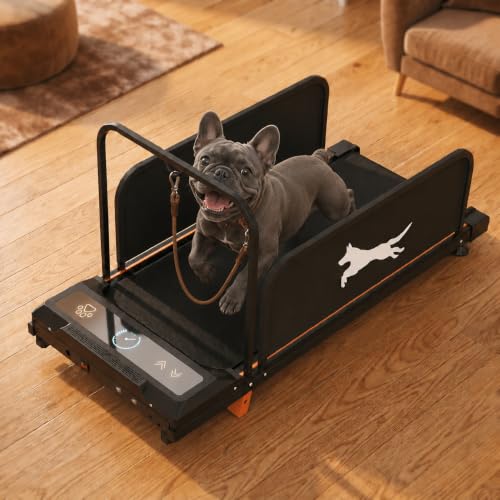

This model is a strong choice for homes that want a quieter, more guided treadmill session indoors. The motorized design, side panels, LCD tracking, and low-noise operation make it appealing for apartment settings or supervised daily exercise. It is also one of the more versatile picks if you want a treadmill that can support structured walking routines.
✓ Quiet motor is a plus for indoor and apartment use
✓ Side panels help keep dogs centered and confident
✓ LCD tracking supports time, speed, distance, and calorie monitoring
✗ Motorized designs require more supervision and careful speed selection
✗ The “small dog” label may not match every dog’s body size in practice
✗ 2-in-1 style features may be more than some buyers need
Best for Track Security: MlemGirove Dog Treadmill with Pin-Hinged Track & 3-Layer Shock Absorption


If your top concern is a secure running surface, this model deserves attention. The pin-hinged slat design is meant to prevent belt detachment, while the disc brake lock and 3-layer shock absorption support safer, more controlled sessions. The built-in monitor also adds a helpful fitness-tracking element for owners who like measurable routines.
✓ Pin-hinged track design is built for stability
✓ Disc brake lock helps secure the treadmill after use
✓ Digital monitor tracks speed and distance
✗ Assembly is described as straightforward, but still requires setup time
✗ Manual slatmill format may not suit every dog immediately
✗ Best for owners who want a more involved training tool
Best Premium: MlemGirove Dog Treadmill with Pin-Hinged Track & 3-Layer Shock Absorption

This is the more feature-rich version of the MlemGirove platform and a strong premium pick for buyers who want the same safety-forward track design with broader setup flexibility. The pin-hinged surface, shock absorption, disc brake lock, and transport wheels make it a compelling option for larger, high-energy dogs that need consistent exercise indoors or outdoors.
✓ Secure pin-hinged running surface
✓ Quiet operation with transport-friendly wheels
✓ Speed and distance monitoring for structured training
✗ Premium positioning may be more than casual users need
✗ Manual treadmill format still requires owner involvement
✗ Best for households ready to commit to regular use
Budget Guide: What You Get at Each Tier
Budget
Budget dog treadmills usually focus on the essentials: a stable frame, basic safety controls, and a straightforward design. In this tier, you’ll often see manual slatmills or simpler motorized units with fewer adjustment options. These are best for buyers who want a functional indoor exercise solution without extra training features.
Mid-range
Mid-range models typically add better cushioning, more thoughtful braking systems, improved track security, and sometimes digital monitoring. This is often the sweet spot for owners who want a balance of safety, comfort, and versatility. You may also see quieter operation and more durable materials in this category.
Premium
Premium dog treadmills usually offer the most refined materials and the most adjustability. Expect features like adjustable incline, stronger frames, improved track construction, more precise control systems, and better comfort-focused details. These models tend to suit committed users, active breeds, or households that plan to use the treadmill regularly as part of a fitness routine.
Frequently Asked Questions
How do I know what size dog treadmill to buy?
Measure your dog’s length, height, and typical stride, then compare those measurements to the treadmill’s running surface and frame dimensions. A treadmill should allow your dog to move naturally without feeling cramped or unstable.
Is a manual or motorized dog treadmill better?
Manual treadmills are often better for self-paced training and more controlled workouts, while motorized models can work well for supervised walking routines. The better choice depends on your dog’s comfort level, your training goals, and how much control you want over speed.
What safety features matter most on a dog treadmill?
Look for a secure track, side panels, a dependable brake or lock, and a stable frame. For many buyers, shock absorption and a non-slip running surface are also important for comfort and confidence.
Can any dog use a treadmill?
Not every dog is a good candidate right away. Puppies, seniors, dogs with joint problems, or dogs with anxiety may need special consideration and veterinary guidance before starting treadmill work.
How long should a dog use a treadmill each day?
That depends on age, breed, fitness level, and the treadmill type. Start with short sessions and build gradually, watching for signs of fatigue or stress. If you’re unsure, ask your veterinarian for guidance tailored to your dog.
Pros
- Adjustable incline and resistance options
- Safety-focused brake and lock systems
- Quiet, stable designs for indoor use
- Shock absorption and paw-friendly surfaces
- Manual and motorized options for different dogs
Cons
- Some models need careful fit planning
- Manual treadmills require more owner involvement
- Motorized units need closer supervision
- Assembly can be time-consuming on some models
Frequently asked questions
How do I know what size dog treadmill to buy?
Measure your dog’s length, height, and typical stride, then compare those measurements to the treadmill’s running surface and frame dimensions. A treadmill should allow your dog to move naturally without feeling cramped or unstable.
Is a manual or motorized dog treadmill better?
Manual treadmills are often better for self-paced training and more controlled workouts, while motorized models can work well for supervised walking routines. The better choice depends on your dog’s comfort level, your training goals, and how much control you want over speed.
What safety features matter most on a dog treadmill?
Look for a secure track, side panels, a dependable brake or lock, and a stable frame. For many buyers, shock absorption and a non-slip running surface are also important for comfort and confidence.
Can any dog use a treadmill?
Not every dog is a good candidate right away. Puppies, seniors, dogs with joint problems, or dogs with anxiety may need special consideration and veterinary guidance before starting treadmill work.
How long should a dog use a treadmill each day?
That depends on age, breed, fitness level, and the treadmill type. Start with short sessions and build gradually, watching for signs of fatigue or stress. If you’re unsure, ask your veterinarian for guidance tailored to your dog.
Score breakdown
- value
- 8.5
- usability
- 8.3
- durability
- 8.7
- performance
- 8.8
- buyerFeedback
- 8.4

How Scout Picks
Specs & standards
We start from manufacturer specs and category standards.
Expert tests
We weigh independent expert and lab test results.
Verified owner reviews
We read patterns across thousands of real owners.
Scout is our illustrated guide — we research from specs, independent expert tests, and thousands of verified owner reviews. We don't lab-test products ourselves.
How we pick →Get the Full Pet Gear Buyer's Guide
Join our free newsletter — we'll send our latest Pet Gear picks, specs and verdicts straight to your inbox.
Free. No spam. Unsubscribe anytime.
Was this review helpful?
Be the first to share your feedback on this review.
Sign in to vote and let us know what you think.
Discussion (0)
No comments yet. Be the first to start the discussion.
Related Reviews

Petcube Bites 2 Review (2026): Specs, Pros & Cons, and Who It's For
The Petcube Bites 2 Lite is designed as a hybrid device: part pet camera, part treat dispenser. That makes it more substantial than a basic indoor camera, but also more useful if you want one device to cover both monitoring and rewarding your pet. The dishwasher-safe treat container is a practical t
eufy Pet Camera 2K Review (2026): Specs, Pros & Cons, and Who It's For
Check Price on Amazon →

Best Interactive Pet Robots Under $200 for Every Budget in 2026: Ranked by Price & Performance
If you’re shopping for the best interactive pet robots in the budget range , the real challenge is finding one that actually keeps your pet engaged instead of gathering dust after a few days. Some options are better for simple chase-and-pounce play, while others add smarter movement, rechargeable co