


Scout's Take
5 picks worth buying
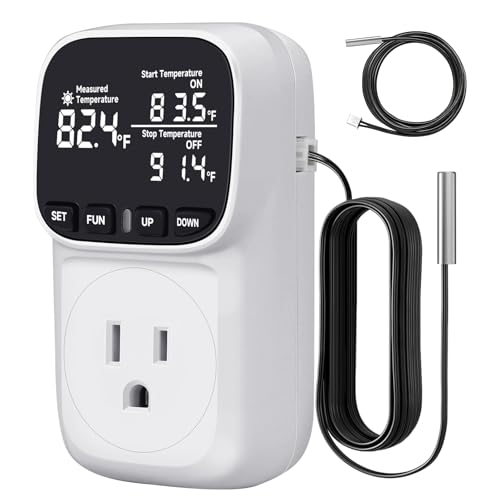
COMYAN Temperature Controlled Outlet with 16.4ft & 6.5ft 2 Probes, Reptile Thermostat 15A 1800W Digital Thermostat, Heating Cooling Timer with Cyclic Timing/Countdown, -40℉~210℉ for Reptile Incubator
The best all-around choice for larger or more demanding reptile setups that need strong control and flexible sensor placement.
- Flexible dual-probe lengths
- High load capacity
- Independent heating/cooling control
- More complex than basic models
- May be more than beginners need
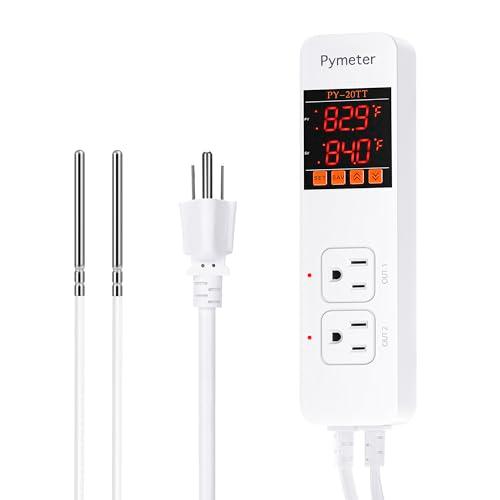
Pymeter Digital Temperature Controller Dual Probe Reptile Thermostat Controlled Outlet for Terrarium Heat Mat Heating Pad, Switch Cooling Fan Freezer Fridge ON & Off at Setpoints 10A 1200W
A smart budget pick for keepers who want dependable dual-probe control without app complexity.
- Two independent outlets
- Dual waterproof sensors
- Helpful safety alarms
- No WiFi control
- Simpler than premium options
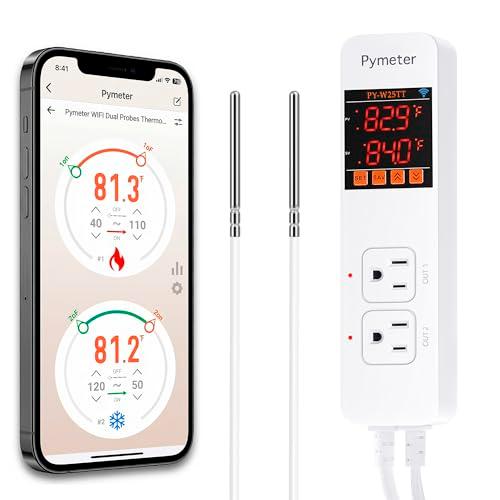
Pymeter SmartLife/Tuya APP WiFi Temperature Controller with Dual Probes, Smart Digital Thermostat with Two Outlets for Reptile Heat Mat, Greenhouse Seedlings, Homebrew Fermentation, Cooling Fan
A strong choice for keepers who want remote alerts and app-based temperature changes.
- WiFi app control
- Dual high-precision sensors
- Independent outlets
- Depends on app connectivity
- More features than some users need
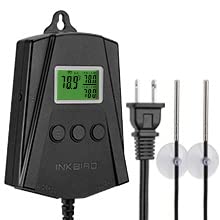
Inkbird WiFi Heat Mat Reptile Thermostat Controller Temperature Controller with 2 Probes and 2 Outlets, IPT-2CH Reptiles Heat Mat Thermostat (Max 250W per Outlet)
Best for users who want data tracking and app visibility in a dual-enclosure setup.
- App monitoring and charts
- Two independent outlets
- Probe error alarms
- Lower per-outlet power limit
- 2.4 GHz WiFi only
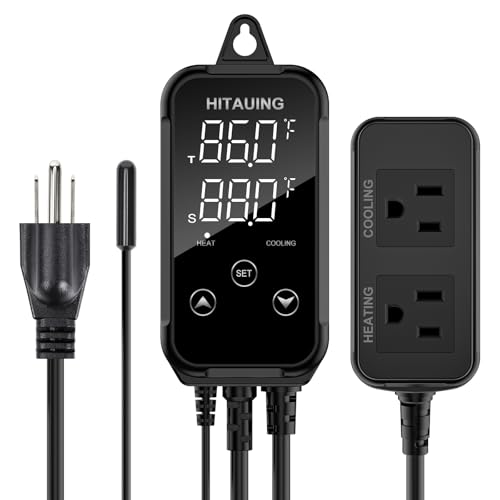
HiTauing Digital Temperature Controller, Aquarium Heater Reptile Thermostat Heating and Cooling Dual Outlet with Seawater-Resistant Probe for Fish Tanks, Reptile Tanks, Greenhouse & Seedling Mat
A flexible all-rounder if you want one controller for reptiles and other temperature-sensitive projects.
- Heating and cooling outlets
- Touch-control display
- Wide temperature range
- Less reptile-specific
- Learning curve for controls
Who this is for: Best for reptile keepers who need accurate dual-zone temperature control and want to match a thermostat to their enclosure size and heating setup.
How to Choose the Best Reptile Thermostat with Dual Probe in 2026: Complete Buying Guide
If you’re trying to figure out how to choose a reptile thermostat with dual probe, the big challenge is balancing precision, safety, and ease of use without overbuying features you won’t need. A dual-probe thermostat can help you manage two zones, compare temperatures in different spots, or keep backup monitoring in place if one sensor is placed in a more critical area. The most common mistake buyers make is choosing a thermostat based only on wattage or app features, then discovering the probes, outlets, or control logic don’t actually match their enclosure setup.
This guide breaks down the features that matter most, the red flags to avoid, and the best research-backed options available right now based on manufacturer specs, published expert commentary, and verified owner feedback.
Key Features to Look For
1) Dual-probe placement and sensor length
With a dual-probe thermostat, the first question is where each probe will go and whether the cable lengths fit your enclosure. Some setups need one probe near the basking area and another in the cool zone; others need a longer lead for a tank across the room or a backup sensor in a second enclosure. If the probe cables are too short, you’ll end up stretching wires awkwardly or placing sensors in the wrong spot, which defeats the point of precise control.
2) Independent heating and cooling control
The best dual-probe thermostats can manage separate heating and cooling outlets, or at least allow independent setpoints for different zones. This matters if you’re using a heat mat, heat lamp, fan, chiller, or ventilation system. For reptiles, that flexibility helps maintain stable conditions through day-night swings and seasonal changes without constant manual adjustment.
3) Accurate temperature monitoring
Accuracy is one of the most important specs because even small swings can affect digestion, shedding, and overall comfort. Look for thermostats that clearly state their monitoring precision, calibration support, and alarm functions. A dual-probe design is especially useful when you want to compare two areas and confirm the enclosure is actually holding the target range, not just reading well in one spot.
4) Safety alarms and fail-safes
High/low temperature alarms, probe-error alerts, and power-delay features can make a big difference in preventing overheating or short-cycling equipment. This is especially important for heat mats and lamps, which can create dangerous hot spots if the controller fails or the probe is misplaced. A good thermostat should help reduce risk, not just switch power on and off.
5) Outlet capacity and load matching
Check the maximum wattage and amperage per outlet before buying. A thermostat that looks feature-rich can still be the wrong choice if it can’t handle your heater, fan, or multiple devices. Matching the controller’s load rating to your actual equipment matters for reliability and safety, especially if you plan to run a larger terrarium, incubator, or multi-zone setup.
6) Display clarity and usability
A clear screen, simple buttons, and readable temperature display make daily checks much easier. Some models offer app control, while others rely on onboard controls only. If you don’t want to navigate menus every time you make a small change, choose a thermostat with a straightforward interface and easy temperature adjustment.
7) App control and remote monitoring
WiFi-enabled thermostats are useful if you want to monitor temperature while away from home or receive alerts remotely. That said, app control is a convenience feature, not a substitute for sensor quality or safe wiring. It’s best for keepers who want remote visibility, data charts, or quick adjustments from a phone, especially in multi-enclosure rooms or breeding setups.
What to Avoid
1) Buying for wattage alone
Higher wattage does not automatically mean better reptile care. A controller can have a strong load rating and still be a poor fit if it lacks accurate probes, separate control logic, or alarms. The right thermostat is the one that matches your enclosure type and heating method, not just the biggest number on the box.
2) Ignoring probe placement limitations
Dual probes only help if you can place them correctly. If the cables are too short, too stiff, or not suited to your enclosure layout, you may end up with inaccurate readings. Avoid thermostats that don’t give enough detail about probe length or sensor use.
3) Assuming app features replace basic reliability
WiFi is nice, but it should never be the main reason you buy a thermostat. If the app is clunky, unsupported, or limited to certain networks, you still need the controller to function safely on its own. Reliability, alarms, and probe quality should come first.
4) Using a controller that doesn’t match the heat source
Some thermostats are better suited to mats, others to lamps, fans, or cooling equipment. A common mistake is buying a unit designed for one type of device and expecting it to handle a very different load or temperature behavior. Always check whether the thermostat is meant for heating, cooling, or both.
5) Overlooking backup safety features
For reptiles, a thermostat should be a safety device, not a convenience accessory. If a model lacks high/low alarms, temperature-difference alerts, or probe fault warnings, it may not give you enough protection for a sensitive enclosure. That’s especially important for species that need stable temperatures around the clock.
Our Top Picks
Best Overall: COMYAN Temperature Controlled Outlet with 16.4ft & 6.5ft 2 Probes
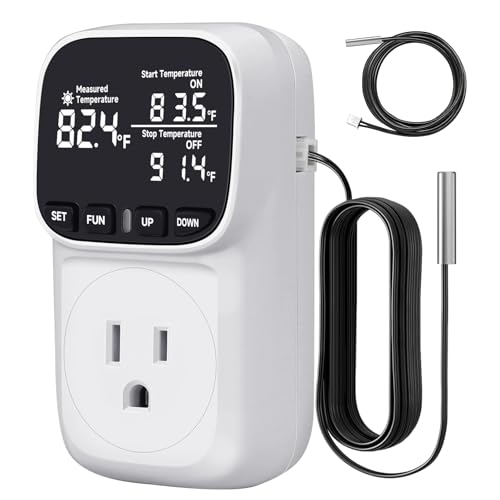

The COMYAN unit stands out for keepers who want a more advanced, heavy-duty dual-probe thermostat with flexible sensor lengths and strong control range. Its independently managed outputs, wide temperature range, and high load rating make it a strong fit for larger reptile setups, incubators, or rooms where the equipment is spread out. The clear display and timing functions also make it appealing if you want more than a basic on/off controller.
- ✓ Dual probes with different lengths for flexible placement
- ✓ High load capacity for more demanding setups
- ✓ Independent heating and cooling control
- ✓ Clear display with broad viewing angle
- ✓ Useful for reptile enclosures and other climate-sensitive spaces
- ✗ More advanced than many beginners need
- ✗ Setup may feel more complex than simpler controllers
Best Budget: Pymeter Digital Temperature Controller Dual Probe Reptile Thermostat Controlled Outlet

This Pymeter model is a practical choice if you want dual-probe control without moving into a more complex smart system. It offers separate outlets for heating and cooling, along with alarms and a power-on delay feature that adds a layer of protection for certain equipment. It’s a strong fit for straightforward terrarium use, dual-zone monitoring, or keepers who want a simple controller with useful safeguards.
- ✓ Two independent outlets with heating and cooling support
- ✓ Dual waterproof sensors for multi-zone control
- ✓ High/low temperature and temperature-difference alarms
- ✓ Power-on delay helps reduce frequent cycling
- ✓ Broad use across terrariums, mats, fans, and more
- ✗ Less advanced than WiFi-enabled options
- ✗ Best for users who prefer simple onboard controls
Best for Remote Monitoring: Pymeter SmartLife/Tuya APP WiFi Temperature Controller with Dual Probes


If you want to monitor your reptile setup from anywhere, this Pymeter WiFi controller is the most convenience-focused pick in the group. It combines dual-probe monitoring with app-based adjustments, alerts, and a simple slider interface for setting ON/OFF ranges. That makes it especially useful for keepers who travel, manage multiple enclosures, or like the reassurance of remote temperature checks.
- ✓ WiFi app control for remote adjustments and monitoring
- ✓ Dual high-precision sensors for two temperature zones
- ✓ Independent heating and cooling outlets
- ✓ App alerts and real-time readings
- ✓ Easy slider-based setup in the app
- ✗ WiFi dependency may not appeal to everyone
- ✗ More features than a basic terrarium may require
Best for Tech-Savvy Keepers: Inkbird WiFi Heat Mat Reptile Thermostat Controller Temperature Controller with 2 Probes and 2 Outlets
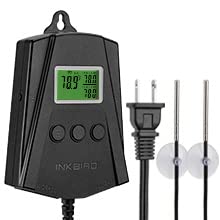
Inkbird’s IPT-2CH is a strong option for keepers who want app-based control plus data tracking. The dual probes and individual outlets make it useful for more than one terrarium, while the app-based charts and alerts can help you spot temperature drift over time. It’s a good fit if you want a more connected controller and are comfortable working within its outlet and WiFi limitations.
- ✓ WiFi monitoring through the app
- ✓ Two independent outlets and probes
- ✓ Data charts and exported data support
- ✓ High/low and probe error alarms
- ✓ Works well for multi-terrarium use
- ✗ Per-outlet power limit is lower than some rivals
- ✗ 2.4 GHz WiFi only
Best for Multi-Use Environments: HiTauing Digital Temperature Controller


The HiTauing controller is a flexible dual-outlet option for keepers who also use the same style of equipment for aquariums, seedling mats, or other temperature-sensitive projects. Its touch-control interface, dual relay design, and wide temperature range make it a practical all-rounder. While it’s not the most reptile-specific model in the lineup, it can serve well if your household uses one controller across multiple environments.
- ✓ Heating and cooling dual outlet design
- ✓ Touch-control LED display
- ✓ Wide temperature range for diverse uses
- ✓ Seawater-resistant probe adds durability for wet environments
- ✓ Useful for reptiles, aquariums, and seedling mats
- ✗ Less specialized than some reptile-first controllers
- ✗ Interface may take a little learning at first
Budget Guide: What You Get at Each Tier
Budget tier
Budget dual-probe thermostats usually focus on the essentials: basic temperature control, a readable display, and enough flexibility to manage a simple terrarium or a small multi-zone setup. In this tier, you can expect practical features like separate outlets, alarms, and straightforward setup, but not necessarily app-based monitoring or advanced data tools. These are best for keepers who want dependable control without extra complexity.
Mid-range tier
Mid-range models often add stronger load capacity, better display quality, longer probe options, or more refined control features such as timing functions and broader temperature ranges. This tier is a sweet spot for many reptile keepers because it tends to balance reliability with convenience. If you have a larger enclosure, multiple heating elements, or a more demanding setup, mid-range is often the most versatile choice.
Premium tier
Premium dual-probe thermostats are usually the most feature-rich. They may include WiFi app control, remote alerts, data charts, calibration support, and more polished interfaces. These are ideal if you want to monitor temperatures away from home, manage several enclosures, or keep detailed records of environmental stability. Premium doesn’t automatically mean “better” for every keeper, but it does offer the most convenience and visibility.
Frequently Asked Questions
Do I need a dual-probe thermostat for one reptile tank?
Not always. If your enclosure is small and has one heat source, a single-probe thermostat may be enough. A dual-probe model makes more sense if you want to monitor two zones, use backup sensing, or manage separate heating and cooling devices.
Where should I place the probes?
Place probes where they best reflect the temperatures your reptile actually experiences. That often means one probe near the warm side or basking zone and the other in a cooler area or near the secondary device you want to control. Avoid placing probes where direct heat will create false readings.
Can I use a dual-probe thermostat with a heat mat and a heat lamp?
Yes, if the thermostat is designed to handle the load and supports the type of control you need. Check whether the outlets are independent and whether the controller is rated for the wattage of both devices.
Is WiFi control worth it for reptile thermostats?
It can be, especially if you travel often or want remote alerts and temperature logs. But WiFi should be treated as a convenience feature, not the main reason to buy. Core reliability, probe quality, and safety alarms matter more.
What is the biggest mistake people make when buying a reptile thermostat?
The biggest mistake is choosing based on wattage or smart features alone and ignoring probe placement, outlet design, and safety functions. A thermostat should fit your enclosure layout and heating method first, then add convenience on top.
Frequently asked questions
Do I need a dual-probe thermostat for one reptile tank?
Not always. If your enclosure is small and has one heat source, a single-probe thermostat may be enough. A dual-probe model makes more sense if you want to monitor two zones, use backup sensing, or manage separate heating and cooling devices.
Where should I place the probes?
Place probes where they best reflect the temperatures your reptile actually experiences. That often means one probe near the warm side or basking zone and the other in a cooler area or near the secondary device you want to control. Avoid placing probes where direct heat will create false readings.
Can I use a dual-probe thermostat with a heat mat and a heat lamp?
Yes, if the thermostat is designed to handle the load and supports the type of control you need. Check whether the outlets are independent and whether the controller is rated for the wattage of both devices.
Is WiFi control worth it for reptile thermostats?
It can be, especially if you travel often or want remote alerts and temperature logs. But WiFi should be treated as a convenience feature, not the main reason to buy. Core reliability, probe quality, and safety alarms matter more.
What is the biggest mistake people make when buying a reptile thermostat?
The biggest mistake is choosing based on wattage or smart features alone and ignoring probe placement, outlet design, and safety functions. A thermostat should fit your enclosure layout and heating method first, then add convenience on top.

How Scout Picks
Specs & standards
We start from manufacturer specs and category standards.
Expert tests
We weigh independent expert and lab test results.
Verified owner reviews
We read patterns across thousands of real owners.
Scout is our illustrated guide — we research from specs, independent expert tests, and thousands of verified owner reviews. We don't lab-test products ourselves.
How we pick →Get the Full Pet Gear Buyer's Guide
Join our free newsletter — we'll send our latest Pet Gear picks, specs and verdicts straight to your inbox.
Free. No spam. Unsubscribe anytime.
Was this review helpful?
Be the first to share your feedback on this review.
Sign in to vote and let us know what you think.
Discussion (0)
No comments yet. Be the first to start the discussion.
Related Reviews
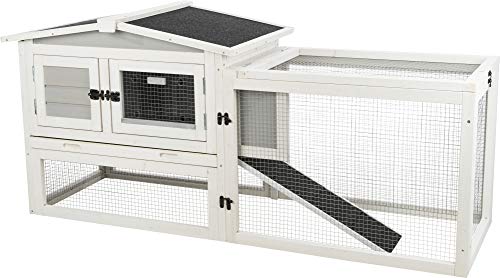
1 Best Insulated Outdoor Rabbit Hutches with Run in 2026 — Safer, Warmer Outdoor Space for Cold-Weather Bunnies
If you’re trying to find the best insulated outdoor rabbit hutches with run , the hard part is balancing warmth, predator protection, and enough space for daily movement. A good winter-ready hutch should do more than look sturdy: it needs insulation, weather resistance, secure mesh, and a run that g

8 Best Large Glass Terrariums for Adult Bearded Dragons in 2026 — Roomier, Easier-to-Manage Enclosures
If your adult bearded dragon is starting to look cramped, the enclosure is probably working against your husbandry instead of helping it. The best large glass terrariums for adult bearded dragons give you the footprint for proper basking and movement, plus the ventilation, access, and cable routing

Best Programmable Terrarium Controllers Over $200 for Every Budget in 2026: Ranked by Price & Performance
If your enclosure keeps swinging too dry, too wet, or too inconsistent, the real problem is usually control, not decor. The best programmable terrarium controllers in the pricier tier are built for keepers who need steadier humidity, more automation, and fewer manual adjustments across the day. In t